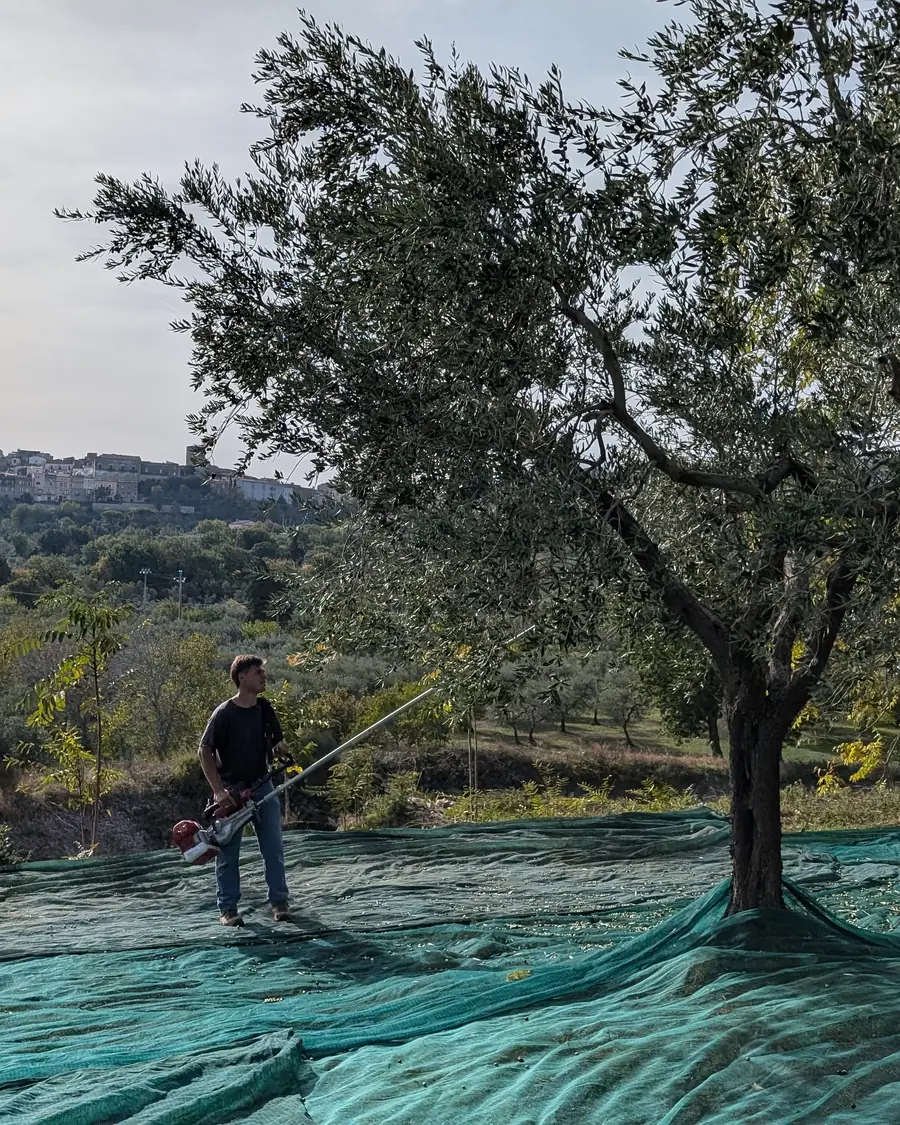
From a local variety of the Ogliarola family, harvested in October and milled within 10 hours at a local mill.

Our extra virgin olive oil is made from local olives of the Ogliarola family, harvested in October and milled within 10 hours at a local mill.
We are in Puglia, a land of olive trees, in Biccari to be precise: a small village in the Monti Dauni hills, in the province of Foggia.
The local variety belongs to the family of the Ogliarola cultivar, better known in the village as “la biccarese”.
medium green fruity, with aromas of almond, grass, artichoke and herbs. On the palate, balanced bitter and pungent notes. Read our tasting guide below!
The absence of defects and the perception of a fruity attribute are the basic requirements for classifying an oil as “extra virgin olive oil”.
the free acidity of our oil is 0,2%, well below the legal limit for extra virgin olive oil (set at 0.8%). Acidity depends on the quality of the olives and is expressed as a percentage of oleic acid, the main monounsaturated fatty acid.
Why does this matter? Polyphenols give the oil its bitter and pungent sensations and protect it from oxidation, helping it keep over time.
At Contrada Ingegnoso we believe that informed consumers value our oil, because they make conscious choices about what they eat.
Our extra virgin olive oil is suited to both raw dressing and cooking, but for a surprising result, try it on vegetable and bean soups!
| Tasting guide: anyone can have a go at tasting! The first step is to pour the oil into a small glass, cover it and warm it in the palm of your hand to heighten the perception of its aromas. The colour, whether more yellow or more green, is not in itself a sign of the oil’s quality. Start with the olfactory assessment: bring the glass close to your nose and breathe in slowly and deeply 2 or 3 times in a row, concentrating on what you perceive. Then move on to the taste assessment: take a small sip of oil, bring it into contact with your taste buds to appreciate its flavour and draw in air between your teeth to perceive the aromatic compounds retronasally. An oil is good when… it recalls the sensation of the fruit it comes from: a healthy, fresh olive. This positive attribute, called fruity, is essential for an oil to be classified as extra virgin olive oil. In a quality oil you can perceive the bitter taste at the back of the tongue before swallowing, and the tactile, pungent sensation in the throat, as when you eat chilli. These two attributes are extremely positive, because they come from polyphenols, antioxidant substances that protect the oil from oxidation. An expert taster’s guidance is essential for carrying out a sensory analysis correctly, but you can put yourself to the test and discover that some notes bring back memories stored in your sense of smell or taste, such as the flavour of almonds or of cut grass. |