17 October 2026
Acidity, peroxides, K232, polyphenols and panel test: what they measure, what the legal limits are and how to read them, with the analyses of our oil.
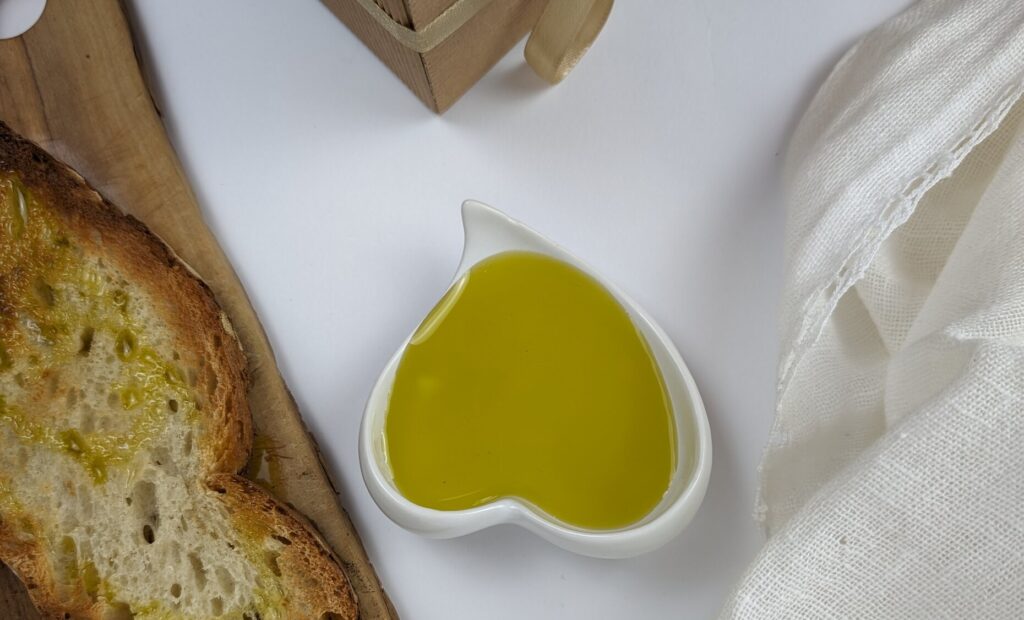
Before bottling our oil we have it analysed in a laboratory and tasted by an official panel. The reports are full of abbreviations and numbers: here we explain what they mean, using the analyses of our oil from the 2023 harvest as an example. We publish the reports of the new harvest on our olive oil page as soon as they arrive.
The chemical analyses were carried out by Chemiservice in Monopoli, a laboratory accredited by ACCREDIA, Italy’s national accreditation body. The panel test was carried out by the Excellence EVO tasting panel in Foggia, recognised by the Italian Ministry of Agriculture. To be called extra virgin, an oil must meet the limits of both: the chemistry and the tasting.
| Parameter | Our oil (2023) | Limit for extra virgin |
|---|---|---|
| Free acidity | 0.21% | up to 0.80% |
| Peroxide value | 5.7 meq O2/kg | up to 20 |
| K232 | 1.85 | up to 2.50 |
| K268 | 0.170 | up to 0.22 |
| ΔK | 0.006 | up to 0.01 |
| Median of defects | 0 | 0 |
| Median of the fruity attribute | 4.5 | above 0 |
The limits are those set by Regulation (EU) 2022/2104.
It measures the fatty acids that have broken away from the triglycerides, and is expressed as a percentage of oleic acid. It rises when the olives are damaged, attacked by the olive fly or left waiting too long before going to the mill. The limit for extra virgin is 0.8%; our oil was at 0.21%.
Acidity, however, cannot be tasted. An oil that catches in the throat is not acidic: that peppery bite comes from the polyphenols.
The peroxide value measures oxidation that has only just begun: it is an index of freshness. The limit is 20 milliequivalents of oxygen per kilo; our oil was at 5.7. It rises over time, all the more if the oil is exposed to light, air or heat: we cover this in how to store extra virgin olive oil.
These are spectrophotometer readings in ultraviolet light. K232 detects the products of early oxidation, K268 (called K270 in some reports) those of more advanced oxidation. ΔK is used to find out whether refined oil has been added to the oil. Our values are all below the limits: K232 1.85, K268 0.170, ΔK 0.006.
These are the substances that give oil its bitterness and pungency and protect it from oxidation. Our oil contained 772 mg/kg in total, measured as tyrosol.
The report also lists the individual molecules. Among them is oleocanthal, 67 mg/kg, the molecule behind the catch in the throat. Polyphenols decline as the months go by: the figure applies to that batch, at the time of the analysis.
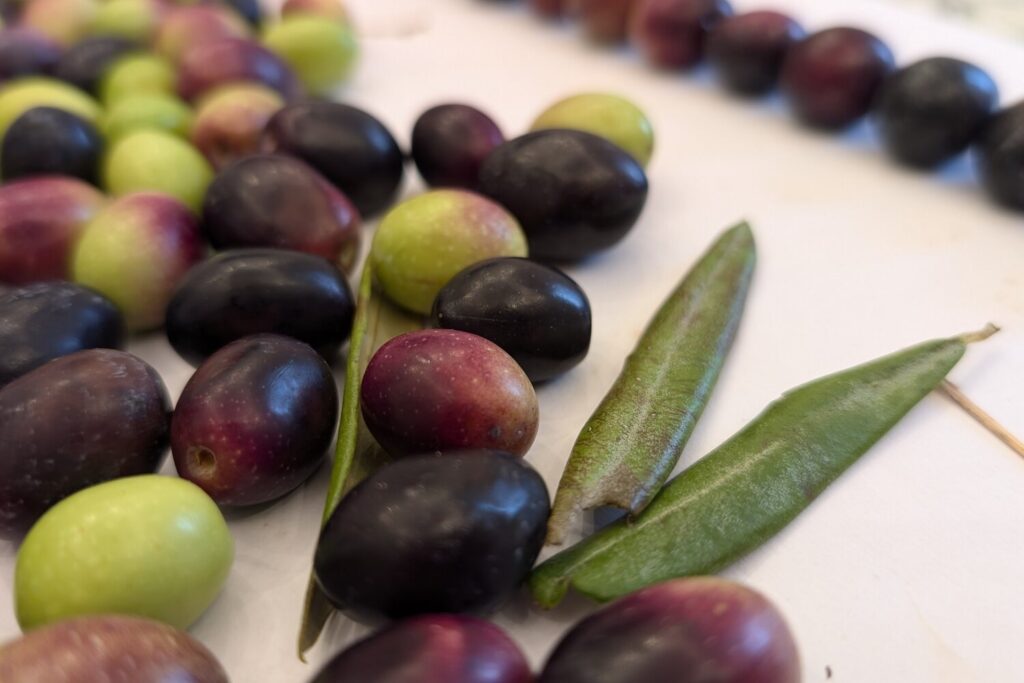
You often read that an oil with more than 250 mg/kg of polyphenols “is good for you”. The wording authorised by the European Union (Regulation (EU) 432/2012) is precise: “Olive oil polyphenols contribute to the protection of blood lipids from oxidative stress”. It may only be used for an oil that contains at least 5 mg of hydroxytyrosol and its derivatives per 20 g of olive oil, that is 250 mg/kg, and the consumer must be told that the beneficial effect is obtained with a daily intake of 20 g of olive oil.
So the number to compare with 250 is not the total polyphenols but the sum of hydroxytyrosol, tyrosol and their derivatives. In the analysis of our 2023 oil it was 293 mg/kg. Lignans, 119 mg/kg, are polyphenols too, but they do not count here.
Chemistry alone is not enough: it is the tasting that says whether an oil is extra virgin. The panel is a group of 8 to 12 trained tasters who taste the oil without knowing where it comes from and score its positive attributes and its defects from 0 to 10. For an oil to be extra virgin, the median of defects must be zero and the median of the fruity attribute above zero.
Our oil in 2023: fruity 4.5, bitter 4.2, pungent 4.1, no defects. The verdict of the panel: a “balanced” oil, medium green fruity, with aromas of almond, grass, artichoke and herbs.
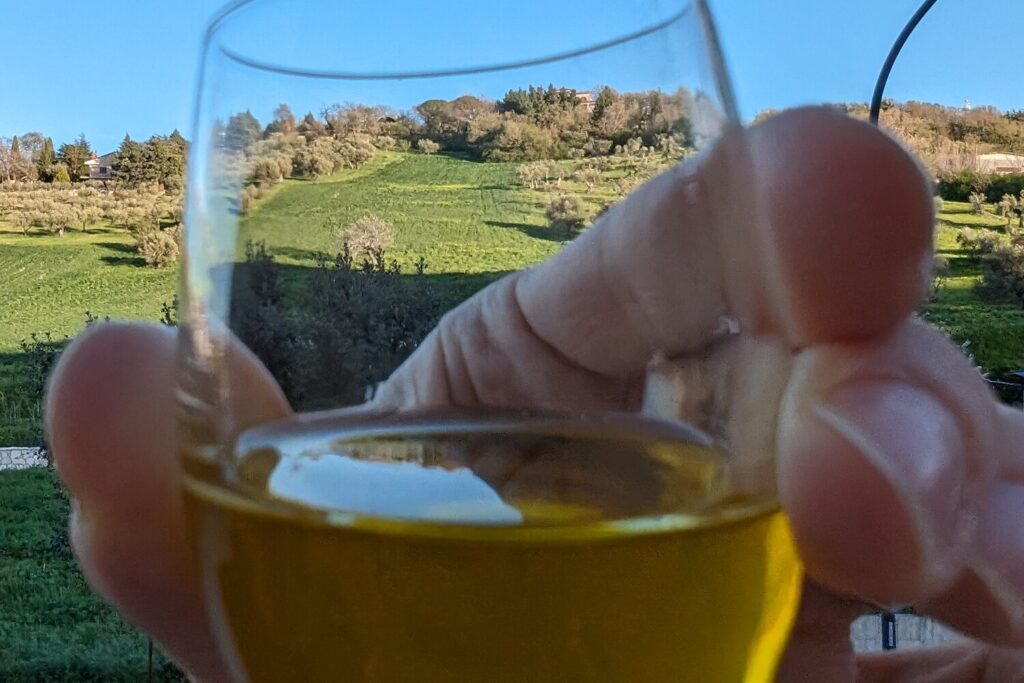
The figures for the harvest on sale are on our olive oil page. If you want to smell and taste what the numbers say, you will find our oil in the shop.
Bring the best of Puglia to your table
Artisan extra virgin olive oil from the Monti Dauni: limited harvest, laboratory analyses, free shipping in Italy over €89.
DISCOVER OUR OILSOriginal price was: €76.40.€68.76Current price is: €68.76. -10%
Pre-order